What Makes a Certified Translation Office in Riyadh Reliable for Your Legal Needs

Selecting a certified translation office in Riyadh for legal matters is a decision that can influence case strategy, compliance, and timelines. Legal stakeholders need translations that are accurate, consistent, and traceable. Reliability is not just a promise; it is the result of a disciplined process that includes qualified linguists, multi-step quality assurance, secure handling, and clear documentation of accountability. In legal contexts, the smallest ambiguity can create risk.
This guide explains how to evaluate reliability, what to expect from certified translation services, and where a specialist provider adds value. Drawing on the operational approach of C-KAT Translations and Interpretations, you will learn practical criteria to assess capacity, competence, and client support. Whether you are general counsel, a legal operations leader, or a practitioner preparing filings, the insights below will help you decide when a provider is suitable for sensitive legal work and how to build a predictable workflow with your translation partner.
Table of Contents
Quick summary
Reliable legal translations depend on structured workflows, qualified linguists, multi-level review, and secure delivery. A dependable provider documents translator credentials, uses terminology controls, and issues a signed statement of accuracy when required. If your matter touches courts or ministries, verify formatting and submission rules before commissioning work.
The comparison table below highlights how a certified translation office differs from freelancers and machine-only outputs.
You will also find a practical framework to evaluate vendors, from scoping and conflict checks to confidentiality and final delivery. C-KAT Translations and Interpretations supports legal teams with certified translation services, interpretation for proceedings and meetings, and coordination that helps reduce project risk while aligning with typical legal documentation practices.
What reliability really means in legal translation
Reliability in legal translation is the consistent ability to deliver accurate, complete, and auditable translations that fit the intended legal use. It involves three pillars.
First: ensure subject matter competence so that legal terms are rendered correctly in context.
Second: process discipline, so every step from intake to delivery is controlled and traceable.
Third: risk management ensures that confidentiality and the chain of custody are preserved. In practice, a reliable provider defines scope in writing, confirms the purpose of use, applies terminology resources, and assigns work to vetted linguists with legal familiarity.
A reviewer performs a second-level check, and a final verifier confirms formatting and completeness. The provider issues a formal statement of accuracy when requested and supplies metadata such as the translator’s name code, date, and version. These steps enable legal teams to reference who did what and when, supporting internal controls and external scrutiny if needed.
Certified Translation Riyadh The Complete Guide to Legally Accepted Documents, Costs, and Processes
Riyadh-Focused Considerations for Legally Sensitive Documents
When your matter is in Riyadh, align early with the requesting authority to confirm what form of certification is required, if any. Requirements can differ by institution or case type. Some authorities request a translator or office stamp, a signed statement of accuracy, or specific language on the cover page. Others may request a notarial act or additional attestations. Always validate the latest instructions directly with the authority or through your legal counsel.
[VERIFY: current Ministry of Justice document acceptance rules for translations in Riyadh and across KSA].
If you are searching for legal certified translation Riyadh or moj accepted translation Riyadh, treat those phrases as starting points for due diligence, not as guarantees. Ask providers to explain which documents they typically support for legal filings and how they format certifications. Also request sample certification wording and a redacted example to confirm structure.
Headquartered in Riyadh and serving clients across the Kingdom, C-KAT Translations and Interpretations supports legal teams with scoping, formatting alignment, and coordination with client-side filing requirements, while encouraging customers to verify authority-specific rules in advance.
Core Criteria to Evaluate a Certified Translation Office
1. Qualifications and allocation
A trustworthy office documents the qualifications of translators and reviewers assigned to legal content. Look for verifiable experience with contracts, pleadings, or regulatory texts. Ask how the office pairs translators and reviewers to balance language mastery and legal familiarity. Should you need named resources, please clarify what information can be shared and what must remain confidential.
2. Defined legal style and terminology governance
Legal meaning often depends on consistent use of terms. A reliable team will build or apply a glossary and style principles that match your jurisdictional preferences. They will ensure version control and disseminate updates to your team, enabling you to verify sensitive terms before they spread throughout documents.
3. Multi-step quality assurance
Quality is a process, not a single review. A dependable office uses separate roles for translation, bilingual review, and final verification. It also documents issue tracking, corrective actions, and approvals. Ask to see a sample workflow that shows how errors are prevented, detected, and resolved.
4. Confidentiality and data handling
Legal work requires controlled access, secure file transfer, and retention policies. A reliable provider explains where files are stored, who has access, how access is revoked, and how files are deleted at the end of retention windows. If you require an NDA or data processing terms, confirm the process and turnaround time for execution.
5. Certification format and traceability
For certified translation services, request the provider’s certification template. It should include an attestation of accuracy, language pair, document identifiers, date, and an authorized signature. If your authority needs additional elements, share those instructions in writing at the outset. [VERIFY DATA: whether notarization or other attestations are required by a specific requesting entity].
Legal Document Types Commonly Requiring Certified Translations
Legal workflows often include documents that may need certification for filing or evidentiary purposes. Typical examples include contracts and appendices, corporate records, powers of attorney, court submissions, judgments, evidence exhibits, expert reports, affidavits, regulatory filings, and immigration-related records.
The exact requirement depends on the forum and purpose of use. Before commissioning work, clarify the submission endpoint and any formatting or binding rules that could influence how pages are laid out, paginated, or sealed. If the translation is being compared line-by-line with the source, request side-by-side formatting. If a separate bound translation is needed, specify cover pages and separator sheets. Early clarity avoids rework and supports predictable timelines.
How Quality Control Protects your Legal Position
Terminology accuracy
Legal meaning is precise. A change from “shall” to “may” can alter obligations. A sound provider uses term bases and legal-style notes to preserve meaning, then flags ambiguous source text for client clarification rather than guessing.
Completeness and formatting
Missing exhibits, stamps, or handwritten notes can trigger rejection. A final verifier checks that every page, annex, and notation is accounted for and that headers, seals, and footers are mirrored when required.
Audit trail
Versioning and sign-off records allow legal teams to show due diligence. If a dispute arises about a translation’s fidelity, a documented trail showing roles and approvals can be essential.
Certified Office vs. Alternatives: What are The Practical Differences?
Different sourcing models offer different risk profiles. The table below summarizes typical distinctions that matter in legal work. This comparison is a general guide. Practices vary by provider and project.
| Reliability factor | Certified translation office | Freelance individual | Machine-only output |
|---|---|---|---|
| Traceability and sign-off | Documented roles, signed statements, version history | Varies by individual; limited formal records | No accountability or signature |
| Multi-step QA | Separate translator, reviewer, verifier | Often single pass unless coordinated | No human legal review |
| Certification format | Established templates and stamps when requested | Possible, but formats vary | Not applicable |
| Confidentiality infrastructure | Secure transfer and access controls | Varies; tools differ by freelancer | Input may be stored externally |
| Terminology governance | Glossaries and style guides | Personal notes; limited scalability | Inconsistent legal terms |
| Capacity and scheduling | Team allocation and backup | Dependent on one person | Fast but unreliable |
| Alignment with authorities | Experienced with common requirements | Varies; experience may be narrow | Not aligned |
A Practical Framework to Choose and Engage The Right Provider
The following framework helps legal teams evaluate a certified office and build a controlled workflow from the first request through delivery. Adapt steps based on the sensitivity and urgency of your matter.
Step 1. Define the legal purpose and endpoint
Identify the forum, filing channel, and due date. Confirm whether certification wording, stamps, or additional attestations are needed. Capture this information in a written brief for the provider so they can plan formatting and resources.
Step 2. Scope and risk mapping
List document types, volumes, languages, and any handwriting or seals to be replicated. Flag confidentiality level, redaction needs, and whether side-by-side formatting is required. Share sample pages to calibrate complexity.
Step 3. Vendor vetting and conflict checks
Request details on translator qualifications for legal content, QA workflow, confidentiality controls, and certification templates. Ask for a redacted sample of a legal certification. If your matter is sensitive, conduct a conflict check to ensure independence.
Step 4. Terminology and style alignment
Provide preferred terms, past approved translations, and any jurisdiction-specific phrasing. Agree on how disputes or ambiguities in the source text will be handled and documented.
Step 5. Pilot and review
Before full rollout, commission a small pilot to validate quality, formatting, and communications. Provide structured feedback and agree on corrective actions.
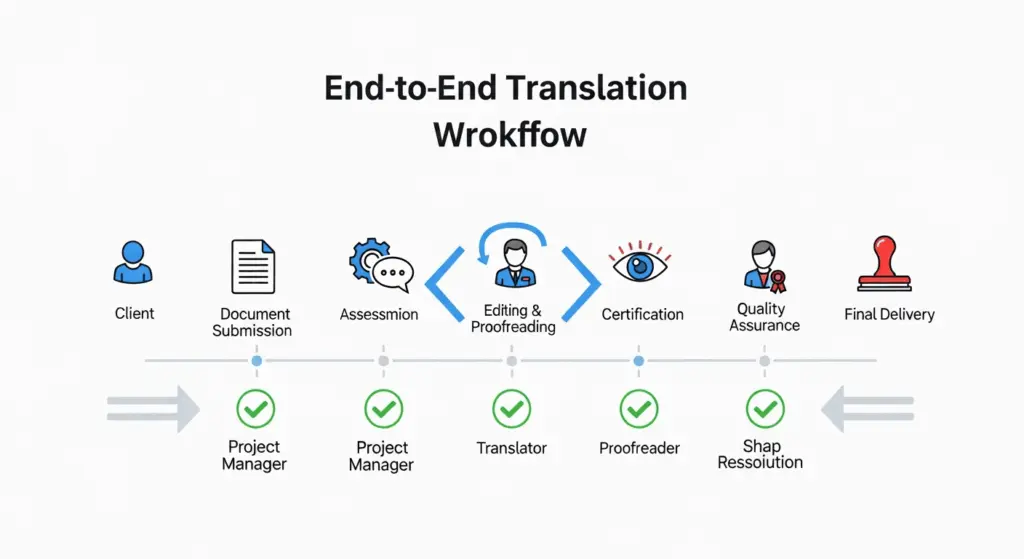
Step 6. Production and multi-level QA
Ensure work passes through translation, bilingual review, and final verification. Maintain a central log of queries and resolutions so decisions are traceable and reusable.
Step 7. Certification and delivery
Confirm final certification wording, signatures, and any stamps. Specify delivery format, pagination, and whether tangible copies or secure electronic signatures are required. Archive all artifacts for audit.
How C-KAT Translations and Interpretations supports legal teams
C-KAT Translations and Interpretations is a Saudi-based language services company serving clients across the Kingdom with certified document translation, professional interpretation, and multilingual communication solutions. For legal stakeholders, we apply structured workflows, assign experienced legal linguists, and coordinate multi-step reviews that support consistent outcomes. We also assist with on-site and remote interpretation for client meetings, hearings, and conferences, we can provide simultaneous interpretation equipment and technical support when proceedings require multilingual access. Headquartered in Riyadh, we support matters across Saudi Arabia through centralized coordination and careful attention to confidentiality, formatting, and delivery of artifacts such as statements of accuracy. We encourage clients to verify any authority-specific requirements and share them early, so our team can align formatting and documentation in a predictable way.
Managing Common Risks in Legal Translation Projects
Ambiguity in source documents
Handwriting, abbreviations, and unclear references can lead to divergence. Mitigate by flagging ambiguous items early and agreeing on a query turnaround protocol.
Terminology drift over long matters
Extended cases can suffer from shifting terminology. Use a living glossary and require each delivery to update or confirm term usage so meaning stays consistent.
Formatting mismatches
Courts or authorities may require specific pagination, seals, or cover pages. Share templates and examples. Run a pre-submission check to confirm layout before final certification.
Confidentiality exposures
Control file access, avoid unsecured channels, and set clear retention rules. Ensure your provider explains storage location, access rights, and deletion processes.
Timeline compression
Urgent matters increase error risk. If time is short, ask your provider about parallel work with controlled checkpoints, and confirm which elements are critical for the first filing.
FAQ: Legal-Focused Certified Translation
A certified translation is a translated document accompanied by a signed statement attesting to its accuracy and completeness. Legal contexts may request certification for filings or evidentiary use. Check the requesting authority’s rules before commissioning.
Ask the authority or your counsel for written instructions on certification format, stamps, and binding. Provide those to the translation office and request a sample certification for alignment.
No provider can guarantee acceptance. Acceptance depends on the authority’s current rules and the case context. Please verify the requirements directly and share them with your provider.
Reliability comes from qualified legal linguists, multi-step QA, terminology governance, secure handling, and clear certification artifacts with traceability.
Provide complete, legible copies with any stamps and annotations visible. Include reference materials and preferred terms. Could you please confirm if originals or notarized copies are required for filing?
Legal teams often need both. C-KAT Translations and Interpretations supports on-site and remote interpretations for meetings and events, and it can supply equipment and technical support if required.
Inform the provider and request that they indicate or reproduce such elements as necessary. Please share any formatting guidelines from the filing authority to help us avoid rework.
Share prior approved translations and ask the provider to build a glossary. Confirm how term changes will be proposed, approved, and recorded for future work.
Conclusion
Choosing a certified translation office in Riyadh for legal matters is about risk control and dependable outcomes. The office you select should demonstrate qualified legal linguists, documented workflows, multi-level review, and secure handling from intake to certified delivery. It should also collaborate on terminology and formatting decisions so your filings are clear, consistent, and aligned with the requesting authority’s instructions.
When you combine these elements, you reduce rework, protect confidentiality, and support your legal strategy with precise language. If you are ready to implement a reliable process for your legal translations, contact C-KAT Translations and Interpretations for expert assistance.