


Certified translation in Saudi Arabia is essential whenever you need to present foreign-language documents to courts, ministries, embassies, universities, or employers. Whether you are applying for a visa, registering a company, filing a case, or evaluating academic credentials, the translation must be accurate, compliant, and accepted by the relevant authority. This comprehensive guide explains exactly how certified translation works in Saudi Arabia, what makes a translation legally valid, when notarization or Ministry of Justice approval may be required, and how to avoid costly rejections.
Drawing on the real-world experience of C-KAT Translations and Interpretations, a Saudi-based certified translation office and language services company, we outline standards for government-approved translation, embassy-accepted translation, MOJ-approved translation for courts, and the full document legalization pathway so you can proceed with confidence.
Table of Contents
Quick Summary
Certified translation in Saudi Arabia converts a document from one language to another in a format that is officially recognized by government bodies, courts, embassies, universities, and employers. A compliant translation typically includes accurate content, proper formatting, translator attestation, official stamps or seals, and, when required, notarization or MOJ alignment. Key use cases include visa document translation, birth certificate translation, academic certificate translation, legal document translation, corporate filings, and medical records. Acceptance rules can vary by authority, so planning, correct terminology, and quality assurance are critical. If you need fast certified translation, work with an approved office that can meet deadlines without compromising compliance.
Useful resource: How Certified Translation Works in Saudi Arabia: Step-by-Step Checklist
What Is Certified Translation in Saudi Arabia?
A certified translation in the Kingdom of Saudi Arabia is an official translation that confirms the translated text is a true and complete representation of the source document. It is typically produced by an approved translation office or qualified translator who attests to the accuracy, includes required stamps or seals, and follows the specific guidelines of the receiving authority. The goal is to deliver an official document translation Saudi Arabian institutions can accept without question.
Certified vs. Notarized vs. Sworn in the Saudi context
While many countries recognize sworn translators, Saudi Arabia primarily operates with certified translations issued by approved offices. Notarized translation in Saudi Arabia involves adding a notary public acknowledgment of the translator’s declaration or the translation office’s attestation. Authorities may request notarization or additional endorsements depending on the document’s purpose and origin. When submitting to Saudi courts, MOJ standards are pivotal. For international use, embassy-accepted translation can require specific layouts, transliteration rules, and additional seals.
When government approval matters?
Some processes require government-approved translation, which means the document must be translated by an office recognized by the relevant authority and then potentially legalized. Requirements differ across ministries, courts, and embassies, so it is wise to confirm acceptance criteria in advance.
Official Documents That Typically Require Certification
Not every document needs a certified translation, but many do when they are used in official procedures. Below are common categories where certified translation is expected.
Immigration and visa documents
- Passports, visas, residence permits
- Marriage and divorce certificates
- Police clearances and affidavits
Personal civil status documents
- Birth certificate translation
- Marriage and divorce certificates
- Family records
Academic and professional credentials
- Academic certificate translation and transcripts
- University diplomas and letters of enrollment or graduation
- Professional licenses and training certificates
Legal and court documents
- Contracts, powers of attorney, articles of association
- Court filings, judgments, evidence documents
- Notices, warnings, and affidavits for litigation
Corporate and business documents
- Commercial registrations and tax certificates
- Board resolutions, minutes, shareholder agreements
- Tenders, proposals, and compliance documentation
Medical and health records
- Medical reports, test results, prescriptions
- Insurance approvals and claims
Each receiving authority may stipulate formatting, stamps, and specific phrasing. For court use, alignment with the Ministry of Justice is essential. For international procedures, embassies and consulates may have detailed instructions for embassy-accepted translation.
The Certified Translation Process: Step-by-Step
Working with an approved translation office can simplify the process and reduce the chance of rework. Below is a typical workflow for Arabic to English translation or English to Arabic for official use.
- Document intake and verification: The office reviews originals or clear scans, confirms legibility, and identifies authority requirements.
- Terminology and transliteration planning: Names, dates, places, and technical terms are standardized according to official spellings, ID documents, or international standards.
- Professional translation: A qualified translator renders the content precisely, preserving legal meaning and formatting conventions.
- Editing and quality assurance: A second linguist or reviewer verifies completeness, consistency, and compliance with target authority specifications.
- Formatting and layout: The translated document mirrors the structure of the source document and includes necessary labels, tables, or seals.
- Certification and stamping: The translation office issues an attestation letter or seal that confirms accuracy and completeness.
- Optional notarization: If required, the translator’s declaration can be notarized.
- Legalization or attestation: For some procedures, additional steps with relevant ministries or embassies may be needed.
- Final delivery: The client receives the certified translation in the requested form, whether physical copies, secure PDF, or both.
Accelerated options exist for urgent cases. However, speed should not compromise compliance. A reputable office will provide fast certified translation while maintaining rigorous controls.
Acceptance Standards: Courts, Embassies, and Ministries
Different institutions follow different rules. Getting this right avoids delays or rejections.
Courts and the Ministry of Justice
For translation for courts in Saudi Arabia, compliance with MOJ expectations is crucial. This includes accurate legal terminology, faithful reproduction of evidence details, and formatting that supports evidentiary use. MOJ-approved translation often requires specific attestations and may be paired with notarization depending on the case.
Embassies and consulates
Embassy-accepted translation often stipulates layout conventions, transliteration standards for names, and sometimes multi-step legalization. Always check the latest guidance from the embassy for the country in question before commissioning translation.
Government bodies and universities
Ministries, regulators, and universities sometimes maintain lists of accepted translation offices and preferred formats. University document translation in KSA may require dual-language layouts and specific grade conversion standards.
Quality, Accuracy, and Terminology Management
Certified translation is more than language proficiency. It is a controlled process that ensures nothing is added, omitted, or misrepresented. Proven practices include:
- Two-step review: translator plus editor to check accuracy and completeness
- Terminology control: a glossary of legal, academic, and medical terms maintained per authority preferences
- Transliteration consistency: names and places aligned with passports or official IDs
- Formatting fidelity: tables, seals, and signatures reflected clearly in the translation
- Version control: clear tracking for updates if authorities request changes
These measures reduce the risk of rejection and protect your timelines.
Data Security and Confidentiality
Official documents often contain sensitive personal, legal, medical, or financial information. Choose an office that maintains confidentiality agreements, secure file transfer, access controls, and data retention policies aligned with regulatory expectations. C-KAT Translations and Interpretations follows strict confidentiality protocols and applies secure technology for file handling and storage.
Industry-Focused Solutions
Certified translation is applied differently across industries. Below are examples of how requirements vary and how to meet them.
Legal
Contracts, POAs, court filings, and evidence documents require precision in legal terminology and formatting that supports court use. A single mistranslation can change the meaning of a clause, so layered review is essential.
Immigration
Visa document translation demands consistent transliteration of names and dates exactly as they appear on passports. Authorities scrutinize these details closely.
Education and Academic
University document translation in KSA often requires grade scales, course titles, and academic statuses rendered consistently to support recognition and equivalency processes.
Business and Corporate
Commercial documents need accuracy with company names, registration numbers, and fiscal data. Tenders may also specify strict submission formats and timelines.
Medical
Medical record translation must preserve diagnostic terms, dosages, and test results. Patient safety depends on exactness.
Government and Embassies
Protocol, seals, and layout requirements can be highly specific. Always confirm the latest acceptance rules with the receiving institution.
Arabic to English and English to Arabic for Official Use
Arabic to English translation for official use, and the reverse, often includes dual-language headings, clear labeling of seals and stamps, and faithful reproduction of structured content like tables or annexes. Key best practices include:
- Consistent transliteration of names based on passports or national IDs
- Preservation of legal numbering, article references, and cross-references
- Clear marking of illegible or missing portions with standardized notes
- Using accepted terminology for government entities, ministries, and courts
By adhering to these principles, your translation will be more readily accepted by regulators, universities, and embassies.
Turnaround Times and Fast Certified Translation
Standard processing varies by document complexity, language pair, and the receiving authority’s requirements. Short personal certificates may be completed within 1 to 2 business days. Longer legal files or multi-document immigration packs require more time. Fast certified translation services bundle streamlined intake, dedicated linguists, and priority QA to deliver urgent documents without compromising compliance.
- Standard timelines: small certificates 1 to 2 days, larger files 2 to 5 days
- Urgent timelines: same day or next day where feasible
- Peak periods: plan ahead to offset seasonal demand
Always notify the translation office of any embassy appointment dates, court deadlines, or tender submission times so they can align production and delivery accordingly.
Comparison and Cost Guide
Understanding service types and pricing helps you plan and budget responsibly. Below is a simplified comparison, followed by typical price ranges. Actual requirements vary by case and authority.
| Aspect | Certified Translation | Notarized Translation | Sworn Translation |
|---|---|---|---|
| Definition | Translation with official attestation and seal by an approved office | Certified translation plus a notary acknowledgment of the declaration | Jurisdiction-specific model with translators appointed by a court or authority |
| Use in Saudi Arabia | Commonly required for government, courts, universities, embassies | Required in some cases depending on receiving authority | Not a typical Saudi model but may be relevant internationally |
| Typical Contents | Translator attestation, stamps, faithful layout | All certified elements plus notary endorsement | Sworn translator’s signature and legal designation per foreign jurisdiction |
| Acceptance Factors | Authority recognition of office and compliance with formatting | Whether a notary is requested by embassy, court, or ministry | Whether foreign authority explicitly requires sworn format |
Typical cost ranges in KSA
- Short personal certificates: typically 80 to 180 SAR per page
- Legal and corporate documents: typically 120 to 300 SAR per page depending on complexity
- Notarization and legalization: additional fees apply
- Urgent service: rush surcharge may apply
These figures are indicative and vary by language pair, technical complexity, volume, formatting needs, and authority requirements. Always request a written quotation and confirmation of acceptance criteria.
Decision-Making Framework: How to Choose a Certified Translation Office?
Selecting the right partner minimizes risk and saves time. Use this framework to decide quickly and confidently.
- Authority fit: Confirm the office is recognized for your specific use case, such as MOJ-approved translation for courts or embassy-accepted translation.
- Experience and specialization: Ask for examples in your industry, such as legal document translation, immigration translation, or academic credential evaluation.
- Quality system: Ensure a documented process that includes editing, terminology control, and compliance checks.
- Security: Verify confidentiality policies and secure file handling.
- Turnaround: Confirm standard and urgent timelines upfront.
- Transparent pricing: Request a clear rate card and itemized quote for extras like notarization or legalization.
- Responsiveness: Choose a partner that communicates proactively and supports your deadlines.
Contact C-KAT Translations and Interpretations for expert assistance in planning and delivering compliant translations for your case.
Location-Based Guidance Across Saudi Arabia
While certified translation rules are national, practical considerations can vary by city. Major hubs offer broader coverage for languages and specialized fields, and some authorities have local procedural preferences. Availability of same-day service, notary access, and courier delivery can also differ.
- Translation services Riyadh, Jeddah, Dammam, Makkah, Madinah, and Al Jubail: larger markets may provide more language combinations and specialized reviewers.
- Appointment lead times: embassies and public bodies may have varying appointment availability.
- Cost differences: pricing can vary by city due to demand and operating costs.
Plan ahead for peak periods and check city-specific instructions for submission, stamping, or pickup. Local knowledge helps with smoother processing.
Document Legalization and Attestation Pathways
Some procedures require not only translation but also legalization to affirm document authenticity across jurisdictions. A typical pathway may include:
- Authenticate the original document in its country of issuance through local authorities.
- Translate by a government-recognized office in Saudi Arabia or as specified by the receiving authority.
- Add notarization if requested by the receiving body.
- Obtain attestation from relevant ministries or the embassy, depending on the destination of use.
Requirements vary widely by country and institution. A qualified office will map the exact pathway for your case, reducing the risk of repeat visits or rejected submissions.
Common Pitfalls and How to Avoid Rejections
Rejections often stem from small but critical issues. Avoid these pitfalls:
- Name mismatches between translation and passport
- Missing seals, stamps, or attestation pages
- Inaccurate dates or inconsistent formats
- Illegible source scans leading to errors
- Failure to follow embassy or court layout conventions
Proactive checks and an experienced office can eliminate these issues and save time.
How C-KAT Translations and Interpretations Supports You
C-KAT is a Saudi-based certified translation office and language services company serving individuals, corporations, and government entities. Our certified translation service covers legal document translation in Saudi Arabia, immigration translation in Saudi Arabia, academic certificate translation, embassy-accepted translation, official document translation in Saudi Arabia, and MOJ-aligned translations for courts.
Beyond translation, we provide attestation support and interpretation for events, meetings, conferences, and seminars, as well as simultaneous interpretation equipment rental with on-site technical support. We combine accuracy, confidentiality, and compliance to meet stringent authority requirements while delivering responsive client service.
Speak with our team to plan your timeline, confirm acceptance criteria, and obtain a transparent quotation tailored to your case.
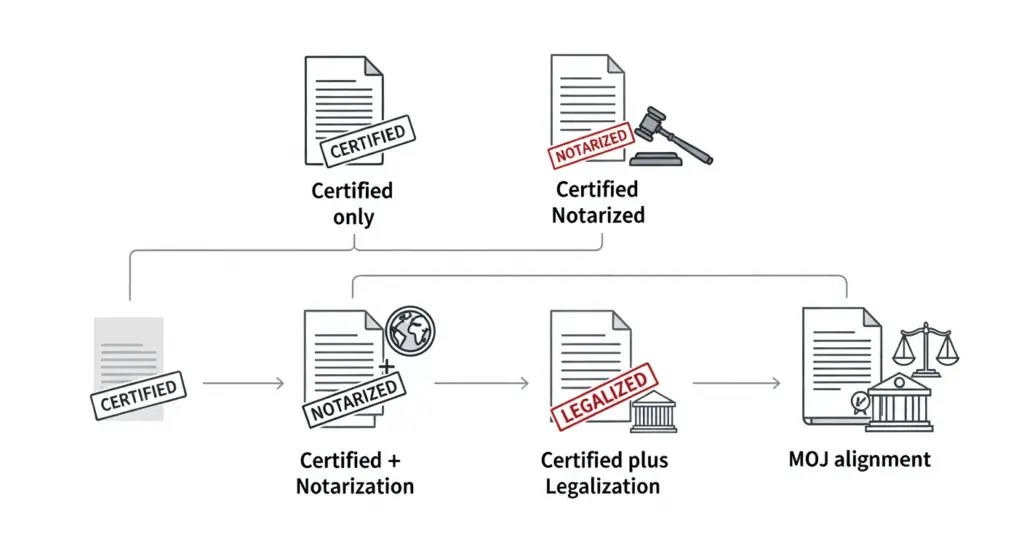
Comparison at a Glance: When You Might Need Extras
Use this quick reference to decide what level of service may be required for your document.
- Certified translation only: personal certificates for local administrative use
- Certified plus notarization: embassy submissions that explicitly request a notarized translator declaration
- Certified plus legalization: documents intended for cross-border legal or academic processes
- MOJ alignment: any translation intended for court submission or legal evidence
FAQs: Certified Translation in Saudi Arabia
A certified translation is completed by an approved office that attests to accuracy and completeness, includes official stamps or seals, and complies with formatting and terminology requirements of the receiving authority.
Not always. Notarization is required only when the receiving authority requests it. Check embassy, court, or ministry instructions for your specific case.
Small certificates can be completed within 1 to 2 business days. Larger legal or academic files may take longer. Urgent service is available for many document types.
If your translation follows MOJ standards, uses accurate legal terminology, and includes required attestations, it is more likely to be accepted. Always confirm court-specific preferences.
Follow embassy-specific rules for layout. transliteration, and legalization. Work with an office familiar with current embassy procedures.
Arabic to English and English to Arabic are the most common for official purposes. Additional language pairs can be supported based on demand and authority acceptance rules.
Yes, provided they are clear and complete. Poor-quality images increase the risk of errors or rejection.
Yes. Academic and university document translation typically includes transcripts, syllabi, and diplomas aligned with recognition requirements.
Pricing is based on language pairing, complexity, volume, formatting, and any extras, like notarization or legalization. Request a written quote for accuracy.
Reputable offices use secure file transfer, access controls, and confidentiality agreements. C-KAT operates under strict data security protocols.
Conclusion
Certified translation Saudi Arabia’s requirements are detailed, but with the right partner, the process is straightforward. Whether you need embassy-accepted translation, MOJ-aligned translation for courts, academic certificate translation, or immigration translation in Saudi Arabia, success depends on accuracy, compliance, and timely delivery. C-KAT Translations and Interpretations provides government-approved translation, fast certified translation options, and end-to-end support for document legalization in Saudi Arabia. Contact C-KAT Translations and Interpretations to plan your documents, confirm acceptance criteria, and move forward with confidence.